

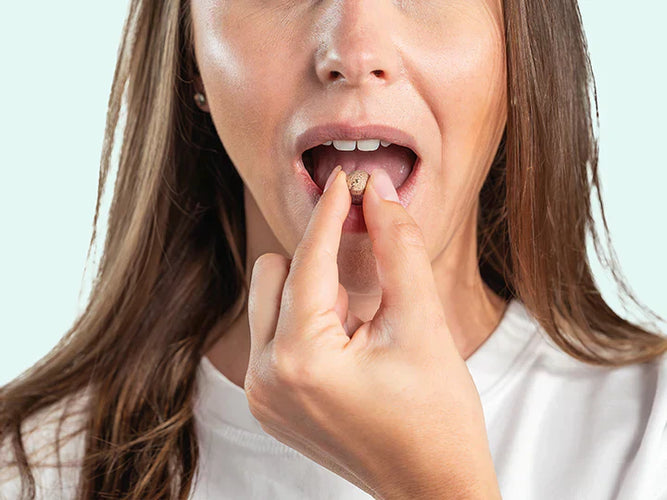
Vitamins are important for healthy hair. They help your hair roots work properly and support hair growth. If you do not get enough vitamins or minerals for a long time, this can affect the thickness and condition of your hair.
In this blog, you will learn which vitamins are important for hair loss, where to find them in food, and when supplementation may be useful.
What is the link between hair loss and vitamin deficiencies?
Your hair grows from the hair root, deep in the scalp. New hair is made there all the time. For this process to work well, your body needs enough nutrients.
If you do not get enough vitamins for a long period, your body must make choices. Processes that are less important for survival, such as hair growth, receive less support. As a result, hair may grow more slowly, become thinner, or fall out more easily.
A vitamin deficiency is rarely the only cause of hair loss. Genetics and hormones often play a bigger role. However, a deficiency can make the problem worse, especially if it lasts for a long time.
When can vitamin supplements help with hair loss?
Vitamin supplements can offer support when:
- You do not get enough nutrients from your diet
- There is a confirmed deficiency
- Your needs are higher, for example due to age or lifestyle.
Vitamin supplements do not always solve the cause of hair loss. However, they can help support normal hair health as part of a balanced approach.
Be careful with dosage
Taking more vitamins or minerals than your body needs does not give extra benefits. In some cases, it can even be harmful. Do not combine different supplements without advice.
Which vitamins are essential for healthy hair?
There are several vitamins that are important for healthy hair. Below, you can read which vitamins are often mentioned in relation to hair loss. For each vitamin, we briefly explain what it does for your hair and which foods contain it. This helps you understand which vitamins your hair needs and when a deficiency may have an effect.
Biotin
Biotin (vitamin H or B8) helps with the structure of the hair. It supports the production of keratin, a building block of hair. Getting enough biotin can help keep your hair strong and resilient. Biotin is found in foods such as nuts, eggs and legumes.
It is important to know that biotin does not automatically cause new hair growth. It mainly helps people who have a deficiency. When biotin levels are too low, hair can become thinner or more fragile. In those cases, biotin can help improve hair condition as part of a healthy diet.
Would you like to learn more about biotin and why it is used in hair products? You can read more on the biotin ingredients page.
The Hair Growth Tablets can support healthy hair. They contain active ingredients that help support existing hair growth. The tablets contain 1,000 µg, which equals 1 milligram of biotin. This amount is considered safe according to scientific studies.

Vitamin D
Vitamin D is often mentioned in relation to hair loss. People with hair loss are more likely to have low vitamin D levels. This does not mean that vitamin D is always the cause of hair loss, but it can play a role.
In many countries, many people produce less vitamin D in autumn and winter. This is because the sun is weaker and we spend more time indoors. If you spend little time outside or keep your skin covered, this can happen more quickly. If hair loss continues, it is sensible to check your vitamin D levels through a blood test. It is also good to know that people with darker skin often produce less vitamin D from sunlight, as the skin needs more sun to make vitamin D.
Vitamin D is found in oily fish, such as salmon and herring, and in eggs. For many people, it is difficult to get enough vitamin D from food alone. As a result, deficiency is quite common, especially in autumn and winter.
Vitamin B12
Vitamin B12 is also known as cobalamin. It helps transport oxygen through the body. Hair roots need this oxygen to work properly. If you have too little vitamin B12, your hair may become thinner or fall out more easily.
Vitamin B12 is mainly found in animal products. People who eat little or no animal-based foods therefore have a higher risk of deficiency. Vitamin B12 is found in meat, fish, dairy products and eggs.
Folic acid
Your body wears out a little every day. Cells become old or get damaged. That is why your body keeps making new cells to replace them. Folic acid helps your body produce these new cells. This is important for your hair, as hair is constantly growing. If you do not get enough folic acid for a long time, your hair may become weaker or feel thinner.
Folic acid is mainly found in green leafy vegetables, legumes, fruit and wholegrain products.
Vitamin C
Vitamin C helps your body absorb iron from food. Iron is important for your hair because it helps carry oxygen to the hair roots. This oxygen is needed for new hair to grow. If your body does not absorb enough iron, your hair may become thinner or fall out more easily. A helpful tip is to combine vitamin C with iron-rich foods, such as vegetables or legumes together with peppers or fruit.
Vitamin C also helps keep your hair and scalp healthy. It supports cell repair and helps your hair stay strong, especially if your hair breaks easily or feels dull.
Vitamin C is mainly found in fruit and vegetables, such as citrus fruits, peppers, broccoli and strawberries.
Vitamin E
Vitamin E helps protect your hair and scalp from damage caused by external factors. These include air pollution, sunlight and other influences that can put stress on the hair. This protection helps keep hair strong and reduces the chance of it breaking or feeling dry.
Vitamin E also supports a healthy scalp. A scalp in good condition provides a better base for hair growth. Vitamin E works best when you get it regularly through food, as your body can then use it evenly. Vitamin E is a fat-soluble vitamin, which means your body absorbs it better when it is eaten together with fats.
Vitamin E is mainly found in vegetable oils, nuts, seeds and avocado.
Which minerals are important for hair loss?
In addition to vitamins, minerals are also important for your hair. Vitamins help processes in the body work properly, such as growth and repair. Minerals are building blocks. Your body uses them to keep your hair, skin and nails strong.
Iron
Iron helps transport oxygen through your body. This oxygen is needed for the hair roots to work properly. If you have too little iron, you may feel tired. Your hair may also become thinner or fall out more evenly across the scalp.
This is more common in women, for example due to menstruation or an unbalanced diet.
Iron is found in red meat, poultry and fish. Plant-based sources such as legumes, spinach and wholegrain products also contain iron, but this form is absorbed less easily by the body.
Zinc
Zinc is important for hair growth and renewal. It helps the hair roots produce new hair and supports a healthy scalp. If zinc levels are too low, hair can become weaker and break more easily.
What many people do not realise is that too much zinc can also be harmful. A high intake can reduce the absorption of other minerals, such as copper. This can be linked to hair loss. For this reason, it is not wise to take extra zinc without a clear reason.
Zinc also plays a role in scalp repair. If the scalp is out of balance, for example due to irritation or flaking, this can affect hair condition.
Zinc is found in meat, dairy products, nuts, seeds and wholegrain products.
Selenium
Selenium helps protect your body from harmful external influences, such as air pollution. This supports a healthy scalp and strong hair. A long-term deficiency can make hair more brittle and cause it to break more easily.
Selenium is a mineral where balance is important. Too little can affect hair condition, but too much is also not recommended. For this reason, it is best to get selenium mainly through food.
Selenium is found in fish, eggs, wholegrain products and nuts, such as Brazil nuts.
Would you like to know which foods are good for your hair? Read more about nutrition for hair growth.
How do you know if you have a deficiency?
A deficiency in vitamins or minerals is not always easy to spot straight away. Symptoms such as tiredness, pale skin, brittle nails or hair loss can be a sign, but they do not tell the whole story.
The only way to be sure whether you have a deficiency is through a blood test. This can be done by your general practitioner or a specialist. Taking supplements without knowing if you are missing something is not always helpful and can sometimes even be discouraged.
Frequently Asked Questions
Which vitamins are helpful for hair loss during menopause?
During menopause, hormonal changes play a major role. Vitamins such as vitamin D, vitamin B12 and folic acid can support hair condition, but they do not solve hair loss caused by hormonal changes.
Which vitamin or mineral deficiencies are most often linked to hair loss?
Deficiencies in iron, vitamin D, vitamin B12 and zinc are most often mentioned in relation to hair loss. This can differ from person to person.
Rescources
Almohanna, H. M., Ahmed, A. A., Tsatalis, J. P., & Tosti, A. (2019). The role of vitamins and minerals in hair loss: A review. Dermatology and Therapy, 9(1), 51–70.
Trost, L. B., Bergfeld, W. F., & Calogeras, E. (2006). The diagnosis and treatment of iron deficiency and its potential relationship to hair loss. Journal of the American Academy of Dermatology, 54(5), 824–844.
Patel, D. P., Swink, S. M., & Castelo-Soccio, L. A. (2017). The use of biotin for hair loss: A review. Skin Appendage Disorders, 3(3), 166–169.


This information does not replace professional medical advice. If in doubt, always consult a doctor or specialist.


